
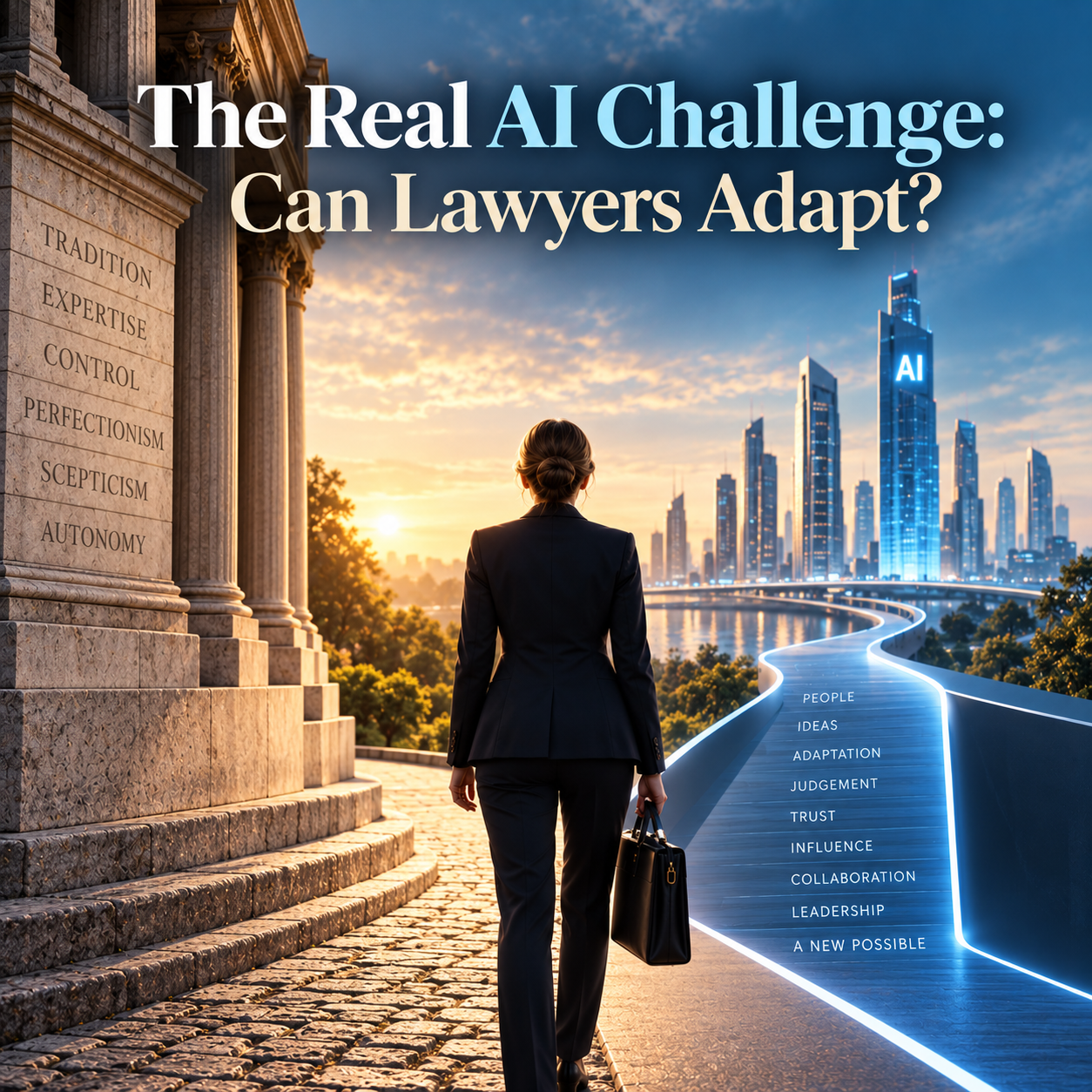
What if we’re having the wrong debate about AI and the law? What if our focus on efficiency and automation is missing the bigger picture? What if the greatest challenge AI poses to the legal profession isn’t technological?
This is more than a technological challenge. It is an adaptive one. The lawyers most likely to thrive in the future will not necessarily be those who master the technology, but those best able to adapt how they work, and how they view themselves.
In our own research study, we are examining why some high-performing lawyers are able to adapt and reinvent themselves, while others remain attached to identities and behaviours that no longer serve them. The answer may unlock what high-performance will look like in the future.
Our hypothesis is that the lawyers most likely to thrive in the age of AI will not necessarily be those with the greatest expertise, but those best able to exercise judgement, build trust, influence others, collaborate and lead. In other words, their ability to adapt to new ways of working, and to reshape their professional identity around them will be key.
Existing research demonstrates that the ability to adapt to change partly depends upon how tightly an individual is attached to their professional identity, how threatening change feels to that identity, and their capacity to create a new version of themselves.
Paradoxically, some of the very qualities that have made lawyers successful may now make it harder for them to adapt, both how they work and how they see themselves. For generations, lawyers have mastered their craft by relying on traits such as their expertise, control, autonomy, self-determination, scepticism and tendency towards perfectionism. These traits do not lend themselves to adapting.
Adapting to change also requires self-awareness, curiosity, flexibility, a tolerance of uncertainty and a willingness to experiment. And herein lies another problem. These are not necessarily the qualities the profession has traditionally valued most or the lens through which lawyers identify.
The threat to lawyers’ professional identity cannot be underestimated. If I’ve built my career on being the expert, what happens when AI knows more than I do? If being in control has always been part of how I work, what happens when I have to give some of that control away? And if I’ve always measured success by my own performance, what happens when my value increasingly comes from how well I lead others, build relationships and use technology?
Consider the case of a senior lawyer client of mine. At the end of a large matter, she was asked to identify which parts of a transaction had been generated or assisted by AI. She didn’t know the answer. She felt out of control. Instantly, she realised the way she supervised her associates would need to change. More disturbing to her was the realisation that the way she was perceived by her client had also changed. (Interestingly, the SRA has since warned that senior lawyers could face regulatory action if they fail to oversee the use of AI appropriately.)
In our leadership programmes for senior lawyers, we’ve recently introduced a module on professional identity: what does it mean to be a lawyer? A few years ago, that would have been viewed as touchy-feely and a sure way to clear the room. Today, it’s a fundamental part of the programme.
Another barrier to successful adaptation is that, under pressure, lawyers, like everyone else, tend to double down on the very behaviours that previously made them successful. So, at precisely the moment they most need to adapt, they fall back on the old habits and assumptions that may now be holding them back.
Adding further fuel to the fire, law firm double binds are everywhere. Lawyers are being told: “Use AI. But don’t make mistakes. Go forth and innovate. But stay accountable and protect confidentiality. Experiment. But maintain billable hours.”
So, we need to have a richer debate. Like death and taxes, technological change is inevitable. Expertise will be acquired differently in the future, if not already the case. And as my partner client found out, value will be judged differently.
That will inevitably require lawyers to let go not just of long-established ways of working, but of parts of the professional identity built around them. So perhaps the real question is: how can lawyers become what the world is asking them to become?
The AI challenge may seem technological. But it is experienced as human. And that’s where we must find the solutions.
This article first appeared in LawCom.